

Blog
VPS vs. Dedicated Server: A Simple Guide to Web Hosting and Server Uses
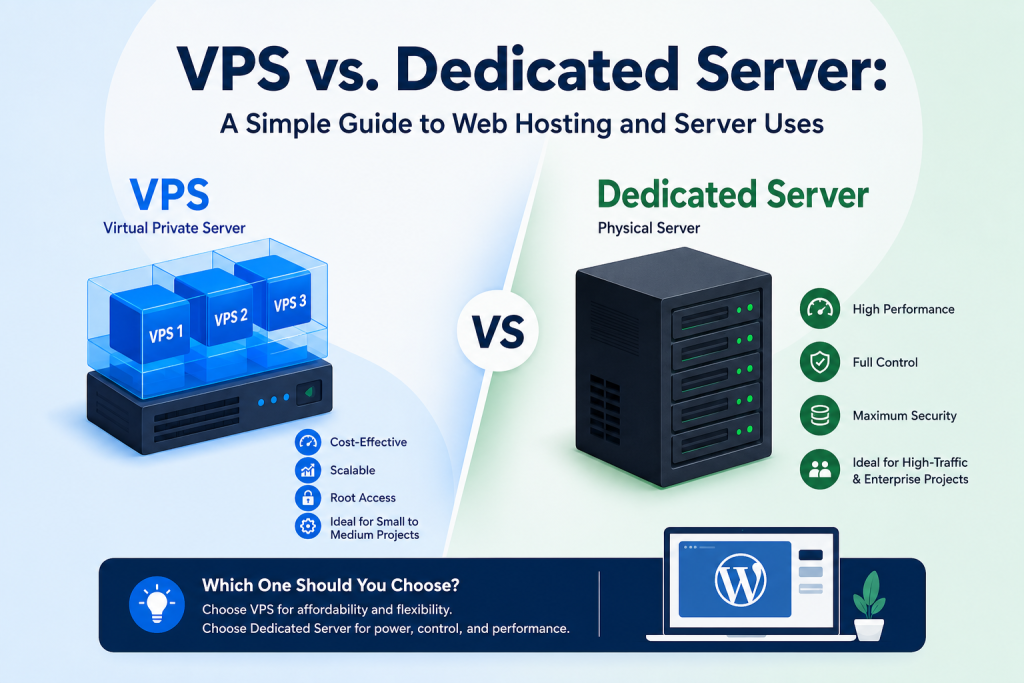
Tabla de Contenidos
When you decide to build a website, an online store, or a web application, the very first thing you need is a place to store your files and keep them accessible to the world. This is called web hosting. If you are just starting a small personal blog or a simple portfolio, basic “shared hosting” might be enough for your needs. However, as your website grows and attracts more visitors, you will quickly realize that you need more power, faster loading speeds, and better security.
This is the exact moment when most website owners start looking at two major hosting upgrades: a Virtual Private Server (VPS) and a Dedicated Server.
Choosing between the two can feel confusing, especially if you are not a computer expert or a seasoned IT professional. But do not worry! In this simple and easy-to-understand guide, we will break down exactly what a VPS and a Dedicated Server are, how they are used in the real world, and how to choose the right one for your specific needs. By the end of this post, you will know exactly which hosting path is best for your online goals.
What is a VPS and What Are Its Uses?
To understand a VPS, let us use a simple real estate analogy. Imagine a large physical server is like a big apartment building. In basic shared hosting, everyone lives in one giant open room. If one person uses too much water or electricity (or server power), everyone else in the room suffers from slow speeds.
A Virtual Private Server (VPS) is like dividing that big building into separate, private apartments. You still share the main building (the physical hardware) with other people, but you have your own private walls, your own kitchen, and your own bathroom. No one else can use the specific resources assigned to your private apartment.
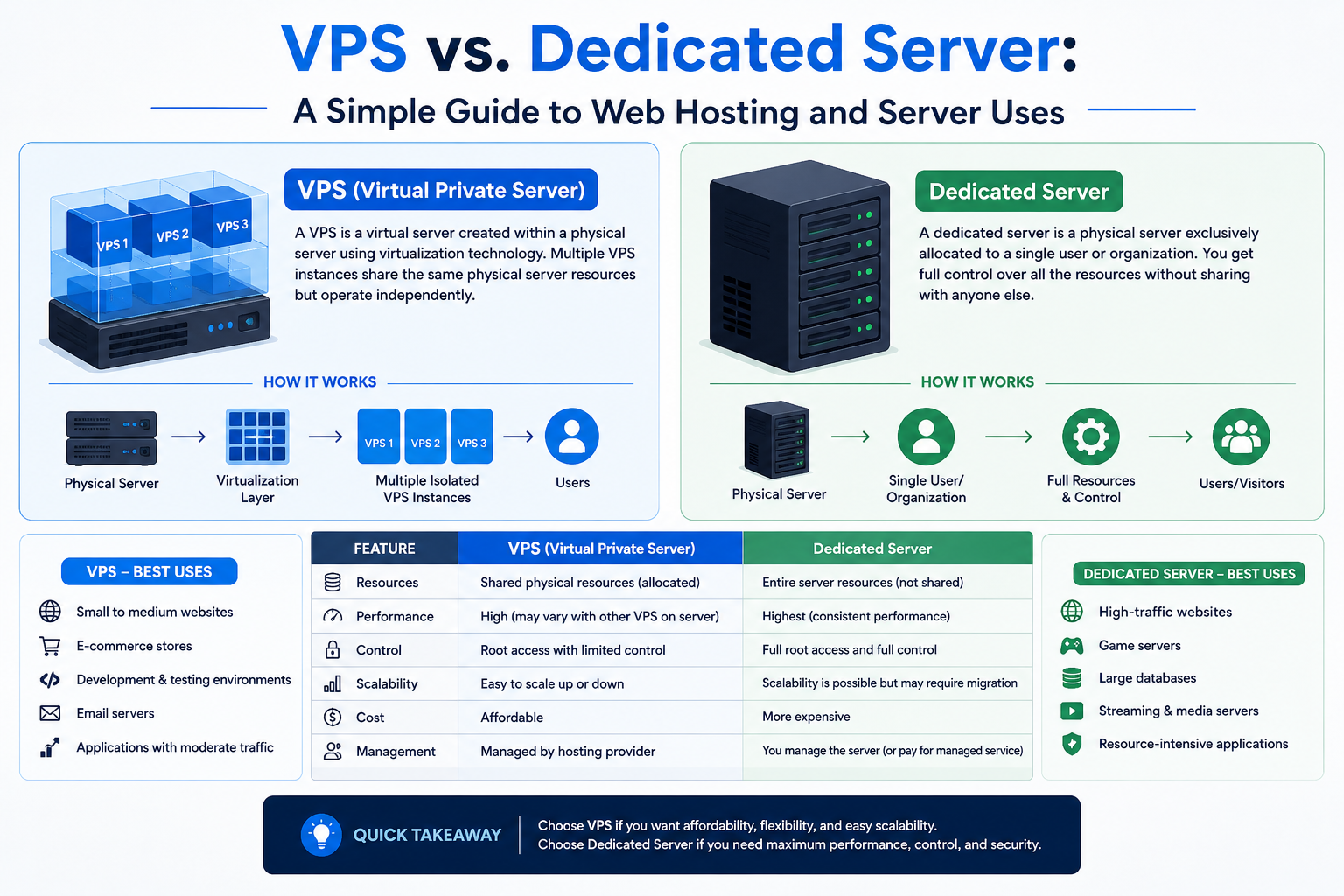
Technically speaking, a VPS uses special software called a “hypervisor” to split one powerful physical server into several smaller, virtual servers. Each VPS gets its own dedicated slice of CPU (processing power), RAM (memory), and storage space. This means your website runs smoothly, regardless of what other users on the same physical machine are doing.
Common Uses for a VPS
Because a VPS gives you your own dedicated resources and full “root access” (meaning you can install almost any software you want), it is incredibly versatile. Here are the most common uses for a VPS:
- Growing Websites and Blogs: If your website gets a lot of daily visitors, shared hosting will start to slow down. A VPS ensures that your website loads quickly, even when traffic spikes. Fast loading speeds are also great for your search engine rankings.
- Small to Medium E-commerce Stores: Online stores need to be fast and secure. Customers will leave your site if it takes too long to load. A VPS provides the speed needed to handle shopping carts, process payments, and keep customer data safe.
- Custom Software and App Testing: Developers love VPS hosting. Because you have full control over the server, you can set up a “staging environment.” This is a safe, private space where developers can test new website features or apps before launching them to the public.
- Hosting Game Servers: If you want to play multiplayer games like Minecraft, ARK, or Rust with your friends, you need a server to host the game world. A VPS is the perfect, cost-effective choice for running private game servers with custom mods and rules.
- Personal Cloud Storage and Email: You can use a VPS to build your own private cloud storage to keep your files safe. You can also use it to host your own custom, professional email addresses for your business.
What is a Dedicated Server and What Are Its Uses?
If a VPS is a private apartment, a Dedicated Server is like owning a standalone, custom-built house on its own plot of land. There are no shared walls, no shared plumbing, and no shared electricity.
When you rent a Dedicated Server, you are renting an entire physical machine. Every single piece of hardware inside that metal box—the processors, the memory, the hard drives, and the network cards—belongs one hundred percent to you. No one else is sharing it.
¿Necesitas el mejor precio en licencias de servidor?
Obtén cPanel, DirectAdmin, LiteSpeed y más con entrega instantánea y soporte 24/7.
Because you have the whole machine to yourself, a Dedicated Server offers the absolute maximum performance, the highest level of security, and total control over both the hardware and the software. It is the ultimate hosting solution for heavy-duty tasks.
Common Uses for a Dedicated Server
Dedicated servers are the heavy lifters of the internet. They are built for tasks that require massive amounts of power, high bandwidth, and strict security. Here are the main uses for a Dedicated Server:
- High-Traffic E-commerce and Enterprise Websites: If you run a massive online store, or a website that gets millions of visitors a day, a VPS might not be enough. A Dedicated Server can handle thousands of simultaneous shoppers without ever slowing down or crashing.
- Large Databases and Data Analytics: Companies that collect, store, and analyze massive amounts of data need serious computing power. Dedicated servers can be equipped with huge amounts of RAM and ultra-fast storage drives to process complex database queries in milliseconds.
- High-Security and Compliance Applications: If you are handling highly sensitive information—such as medical records, financial data, or credit card information—you need maximum security to meet legal compliance standards. A Dedicated server ensures that your data is physically isolated from other users, greatly reducing the risk of security breaches.
- Video Streaming and Media Hosting: Streaming high-definition video requires a lot of bandwidth and processing power. Dedicated servers are perfect for hosting video platforms, large file downloads, or media-rich websites that need to deliver heavy content to users all over the world.
- Complex Network Infrastructure: Large businesses often use Dedicated Servers to run their internal networks, manage complex email systems for thousands of employees, or act as the main “hub” that connects various other cloud services together.
VPS vs. Dedicated Server: Which Should You Choose?
Now that you know what they are and how they are used, how do you actually choose between a VPS and a Dedicated Server? It comes down to three simple factors: your budget, your traffic, and your technical skills.
Choose a VPS if:
- You are on a moderate budget. VPS hosting is much cheaper than dedicated hosting.
- Your website is growing, but you are not getting millions of visitors just yet.
- You want a good balance between high performance and affordable pricing.
- You need to install custom software but do not need absolute top-tier physical hardware.
Choose a Dedicated Server if:
- You have a larger budget and need the absolute best performance money can buy.
- Your website or application gets massive, heavy traffic every single day.
- You are handling highly sensitive data and require strict, isolated security for legal compliance.
- You need to customize the actual physical hardware (like adding specific types of hard drives or extra processors).
The Missing Piece: Managing Your Server Easily
Whether you choose a VPS or a Dedicated Server, you will quickly run into one major problem: managing it is hard.
Servers do not come with a pretty, easy-to-use screen. They run on command lines and code. If you want to create a website, set up an email address, or manage a database, doing it through raw code can be a nightmare for beginners and even for busy professionals.
This is where Hosting Control Panels come in. A control panel is a visual, user-friendly dashboard that sits on top of your VPS or Dedicated Server. It turns complex code into simple buttons and menus. To use these dashboards, you need to purchase Hosting Licenses.
The three most popular and powerful hosting licenses in the world are:
- cPanel: The most famous control panel in the world. It is incredibly easy to use and is the industry standard for managing websites, emails, and databases on Linux servers.
- Plesk: A fantastic, modern alternative to cPanel. Plesk is unique because it works perfectly on both Linux and Windows servers, making it highly versatile for different types of projects.
- DirectAdmin: A lightweight, super-fast, and highly affordable control panel. It uses fewer server resources than the others, which means more power is left over for your actual website.
Getting a license for cPanel, Plesk, or DirectAdmin is the smartest thing you can do after buying your VPS or Dedicated Server. It saves you hours of frustrating technical work and lets you manage your server like a pro.
Ready to Upgrade Your Hosting?
Upgrading from shared hosting to a VPS or a Dedicated Server is the best way to make your website faster, safer, and ready for the future. But remember, a powerful server is only as good as your ability to manage it. Do not let complex code slow you down.
Join us today and check out our premium hosting licenses! We offer instant activation for cPanel, Plesk, and DirectAdmin licenses at the best prices on the market. Get your license now, install it on your VPS or Dedicated Server, and take full, easy control of your web hosting environment today!